


Link to project website: https://www.eurescom.eu/archive/SLICENET/
Social media: Twitter @SliceNet_5G
Contact: Slicenet-Contact@5g-ppp.eu
Horizon 2020 – Call: |
H2020-ICT-2016-2 |
Topic: |
ICT-7-2016 |
Type of action: |
R&I |
Duration: |
36 Months |
Start date: |
1/6/2017 |
Project Title: |
SLICENET: End-to-End Cognitive Network Slicing and Slice Management Framework in Virtualised Multi-Domain, Multi-Tenant 5G Networks |
Overall Objectives
- SliceNet aims to design, prototype and demonstrate an innovative, verticals-oriented, QoE-driven 5G network slicing framework focusing on cognitive network management and control for end-to-end slicing operation and slice-based/enabled services across multiple operator domains in SDN/NFV-enabled 5G networks. In detail the SliceNet objectives are:
- Achieve an innovative, cognitive, integrated ‘one-stop shop’ 5G slice management framework for vertical businesses and co-designed by vertical sectors
- Enable extensible, end-to-end slice FCAPS management across multiple planes and operator domains
- Establish cognitive, agile QoE management of slices for service assurance of vertical businesses
- Enable slicing-friendly infrastructure and coordinated, true provisioning and control of user-definable slices
- Demonstrate the efficiency and support of the SliceNet framework in delivering slice-based/enabled, diverse 5G use cases for verticals, leverage Phase 1 projects’ results, and contribute key integration results to the Phase 2 demonstration process
- Contribute to the standardisation and helping fill the standards gaps
Objectives in terms of vertical applications
Three vertical use cases were identified for the 5G PPP Phase 2 SliceNet project slicing architecture development and associated pilots as follows:
- eHealth
The objective of the eHealth use case pilot is to use dynamic 5G slicing for in ambulance diagnostic service s for patients suffering from stroke.
- Smart Grid
The objective of the SliceNet 5G Smart Grid pilot is to improve electrical power grid Fault Detection Isolation and Restoration (FDIR), thereby reducing frequency and duration of power outages.
- Smart City
The Smart City use case seeks to define a 5G network slicing architecture for Smart Lighting application, such as metering solution (gas, energy, water), remote monitoring of city infrastructure (pollution, temperature, humidity, noise), real-time traffic information and control, city or building lights management and public safety alerts for improved emergency response times.
SliceNet Achievements
In the first year of the project, the following technical progress was achieved:
- Network slicing control, management and orchestration architecture definition
- MEC platform and programmable infrastructure
- RAN slicing & data plane programmability control
- Plug & Play control
- Cognitive management framework definition
- Use cases definition & early prototyping
In the second year, the following technical progress was achieved in the project:
- Move to agile Development Process
- Refined SliceNet architecture
- End-to-end network slice: semi-automatic deployment
- Network slice FCAPS management: design & prototyping Iteration 1
- Cognitive management framework & algorithms – design & prototyping Iteration 1 & 2
- Plug & Play management – design & prototyping
- One-Stop API – concept definition
- Use cases prototyping Iteration 2
- Multi-domain network slice
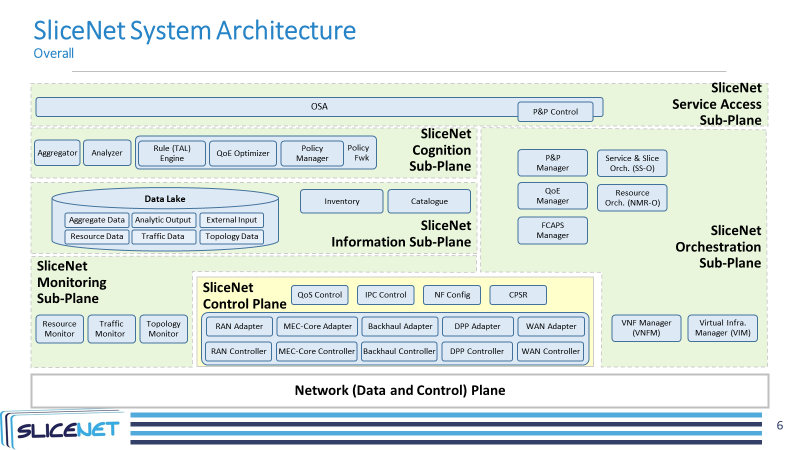
SliceNet Overall Architecture
SliceNet Impact and commercialization opportunities
- eHealth
The eHealth use case contributes to the global competitiveness of European 5G systems by providing prioritised life critical video streaming from inside a high-speed moving ambulance, through dynamic network slicing, coupled with prioritised quality of service. The pilot has achieved reliable and dependable Quality of Service (QoS) and Quality of Experience (with ‘zero perceived’ downtime). SliceNet partners have developed an innovative 5G connected telemedicine system that supports edge-based machine learning to provide paramedics and hospital clinicians with rapid prehospital in-ambulance diagnostics that enhance and improve patient outcome. Commerciaisation opportunities lie in the potential to detect and treat stroke patients pre-hospital or in-ambulance.
- Smart Grid
The impact of the Smart Grid use case contributes to the “global competitiveness of European 5G systems” through innovative solutions in the Smart Grid area. It uses self-healing solutions which
- help reduce the frequency and duration of outages to the consumers through implementation of dynamic 5G slicing, with Ultra-Reliable Low Latency Communications (URLLC) capabilities.
- improve the grid reliability indicators, reducing the financial impact for the electric power utility suppliers
The pilot includes an energy utility and a telecommunications operator supplying the Smart Grid equipment and network infrastructure necessary for providing the E2E Network Slice to the vertical. Using these 5G technology URLLC capabilities, energy companies can implement the Self-Healing Smart Grid scenarios and save costs/improve customer satisfaction by reducing the frequency and duration of outages to consumers.
- Smart City Lighting
The impact of the Smart City lighting use case is innovation in programmable infrastructure deployment with 5G network resource, slice and services monitoring and collected data explosion. This includes
- service QoS/QoE KPIs assurance and metrics (bandwidth, delay, jitter, packet loss)
- service provision within proper IoT – mMTC provisioned slice
- a new operational model for deploying, operating and system service assurance
There are two options to commercialise
- the service application (all or part of the components). The application can be sold standalone w/o linking it to the programmable infrastructure. This will provide the customer advanced functionalities over the lighting solution.
- the End to End Solution, including: application components, marketplace, Vertical
Project Participants:
| Eurescom | Germany |
| Altice Labs | Portugal |
| University of the West of Scotland | UK |
| Nextworks | Italy |
| Ericsson Telecomunicazioni | Italy |
| IBM Israel Science and Technology Limited | Israel |
| EURECOM | France |
| Universitat Politècnica de Catalunya | Spain |
| RedZinc Service Ltd. | Ireland |
| OTE – The Hellenic Telecommunications Organisation | Greece |
| Orange Romania | Romania |
| EFACEC Energia | Portugal |
| Dell EMC | Ireland |
| Creative Systems Engineering | Greece |
| CIT – Cork Institute of Technology | Ireland |
| Orange France | France |